In glycolysis 4 ATP are generated through substrate-level phosphorylation. Glycolysis- Steps ATP generation and Significance.
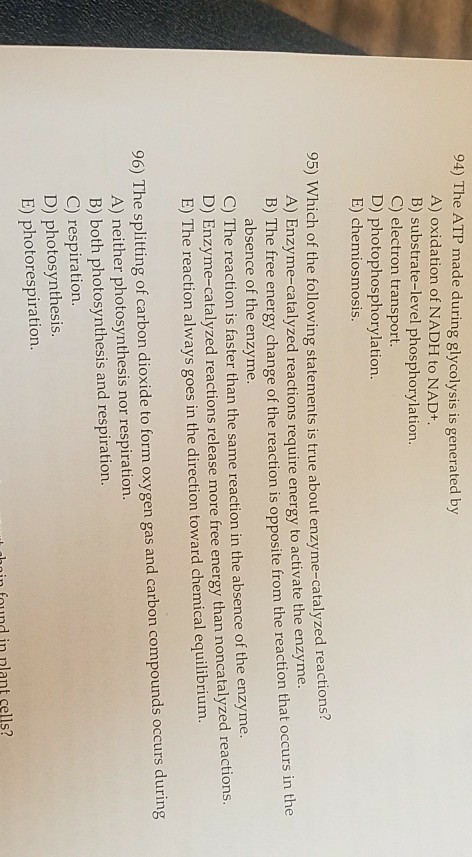
Solved 94 The Atp Made During Glycolysis Is Generated By A Chegg Com
The oxygen consumed during cellular respiration is involved directly in which process or event.
. Pyruvate the end product of glycolysis enters mitochondria during aerobic respiration where it is completely oxidised to release CO 2 and electrons are transferred to oxygen coupled with the synthesis of ATP oxidative phosphorylation. B transferred directly to ATP. The energy generated during PC breakdown allows ADP and Pi to recombine and form additional ATP.
The ATP is molecules are generated during glycolysis in the last reaction of the pathway ie. C used to phosphorylate fructose to form fructose-6-phosphate. The hydroxyl groups allow for phosphorylation.
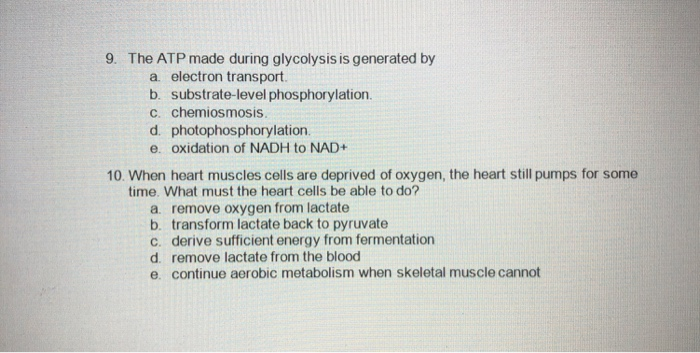
10 The ATP made during glycolysis is generated by A substrate-level phosphorylation. This process occurs in the cytoplasm of the cell. With the conversion of phospho enol pyruvate PEP to pyruvate by the enzyme pyruvate kinase.
The ATP made during glycolysis is generated by the process of. How many ATP are produced in electron transport chain. When heart muscles cells are deprived of oxygen the heart still pumps for some time.
The ATP is molecules are generated during glycolysis in the last reaction of the pathway ie. Fermentation and respiration are two major strategies for energy conservation in chemoorganotrophs. The electron transport chain b.
The specific form of glucose used in glycolysis is glucose 6-phosphate. Biology textbooks often state that 38 ATP molecules can be made per oxidized glucose molecule during cellular respiration 2 from glycolysis 2 from the Krebs cycle and about 34 from the electron transport system. 2 ATPs are produced in the TCA cycle per glucose molecule 2 acetyl CoA.
What must the heart cells be able to do. Biology questions and answers. Most of the ATP produced by aerobic cellular respiration is made by oxidative phosphorylation.
Glycolysis is a complex enzyme-controlled set of reactions. Thanks for asking Hong Lau. ATP released in payoff stage 4.
D stored in the NADH produced. Substrate level phosphorylation c. The ATP produced during glycolysis is generated by which of the following.
O the electron transport chain Oxidative phosphorylation Photophosphorylation chemiosmosis O substrate-level phosphorylation. Electron transport chain This stage produces most of the energy 34 ATP molecules compared to only 2 ATP for glycolysis and 2 ATP for Krebs cycle. The enzyme hexokinase phosphorylates or adds a phosphate group to.
Acetyl-CoAs entrance into the citric acid cycle is the beginning of stage III of catabolism. A total of 2 ATP is derived in the process Glucose 2 NAD 2 ADP 2 Pi 2 Pyruvate 2 NADH 2 H 2 ATP 2 H2O. Glycolysis also synthesizes pyruvate which enters mitochondria where it participates in synthesizing a lot more ATP in cellular respiration.
This pathway is a step-wise process in which 2 ATPs are consumed in preparatory stage and 4 ATPs are released in payoff stage as shown below. Hence net ATP during glycolysis 4-2 2. For example when 13 phosphoglycerate converts into 3 phosphoglycerates and when phosphoenol pyruvate converts into pyruvate ATP is produced through substrate level phosphorylation.
7 The ATP made during glycolysis is generated by A substrate-level phosphorylation. Similarly in what stage of catabolism is the most ATP produced. The electron transport chain takes place in the mitochondria.
The end products of glycolysis are two molecules of ATP two molecules of pyruvate and two molecules of NADH. D stored in the NADH produced. During glycolysis when glucose is catabolized to pyruvate most of the energy of glucose is A transferred directly to ATP.
How many ATP is produced in TCA cycle. B accepting e- at the end of hte e- transport chain An e- loses potential energy when it B shifts to a more electronegative atom. A total of 2 ATP is derived in the process Glucose 2 NAD 2 ADP 2 Pi 2 Pyruvate 2 NADH 2 H 2 ATP 2 H2O.
No ATP molecules are produced during glycolysis. During glycolysis glucose ultimately breaks down into pyruvate and energy. With the conversion of phospho enol pyruvate PEP to pyruvate by the enzyme pyruvate kinase.
So ATP made during glycolysis is generated by substrate-level phosphorylation as ATP is produced by direct addition of phosphoryl group from intermediates. During glycolysis when each molecule of glucose is catabolized to two molecules of pyruvate most of the potential energy contained in glucose is A transferred to ADP forming ATP. The pathway of the breakdown of glucose into pyruvic acid is termed as glycolysis.
Glycolysis is a series of biochemical reactions in cell cytosol which consumes two ATP molecules while synthesizing four ATP molecules for a net gain of two ATP molecules. E transferred to ADP forming ATP. The ATP made during glycolysis is generated by which of the following.
Glycolysis is a cytoplasmic mechanism that provides energy by breaking down glucose into two three-carbon molecules. It is also called the EmbdenMeyerhofParnas pathway. C retained in the two pyruvates.
This stage converts the NADH into ATP. Oxidation of NADH to NAD 10. Pyruvate is first converted into acetyl CoA by oxidative decarboxylation.
Carbon dioxide is considered a waste product of cellular respiration. Advertisement New questions in Biology Help. ATP consumed in preparatory stage 2.
The ATP made during glycolysis is generated by a. This newly produced ATP can now be degraded to release energy for activity. Glycolysis is the process of breaking down glucose into two molecules of pyruvate.
Most of the ATP produced by aerobic cellular respiration is made by oxidative phosphorylation. During recovery when oxygen becomes available NAD attaches to hydrogen from lactate to form ATP. O substrate-level phosphorylation O noncyclic photophosphorylation O photophosphorylation O conversion of NADH to NAD O electron transport chain Light energy varies in energy depending on the of electromagnetic radiation.
Apart from the 4 ATP 2NADH are also produced during the glycolysis which is used during the oxidative phosphorylation and produce 4-6 ATP. With the help of the enzyme hexokinase glucose is. Biology textbooks often state that 38 ATP molecules can be made per oxidized glucose molecule during cellular respiration 2 from glycolysis 2 from the Krebs cycle and about 34 from the electron transport system.
During glycolysis glucose ultimately breaks down into pyruvate and energy. E used to phosphorylate fructose to form fructose 6-phosphate. The glycolytic pathway is a major metabolic pathway for microbial fermentation which involves the catabolism of glucose into pyruvate.
B retained in the pyruvate. Therefore the correct answer is E. A net of two ATP molecules are produced through glycolysis two are used during the process and four are produced Learn more about the 10 steps of glycolysis below.
The energy from ATP and NADPH energy carriers generated by the photosystems is used to attach phosphates to phosphorylate the PGA.
The Atp Made During Glycolysis Is Generated By What Quora
Solved 9 The Atp Made During Glycolysis Is Generated By A Chegg Com
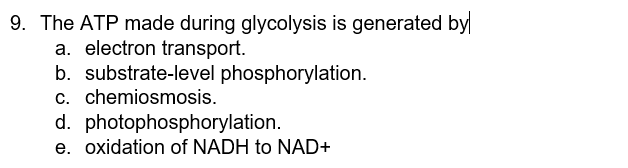
Solved 9 The Atp Made During Glycolysis Is Generated By A Chegg Com
The Atp Made During Glycolysis Is Generated By What Quora



0 Comments